One million views on a YouTube Short sounds enormous.
And in terms of reach, it is.
But if you are expecting one million Shorts views to produce thousands of dollars in advertising revenue simply because a long-form YouTube video might, the result can be surprising.
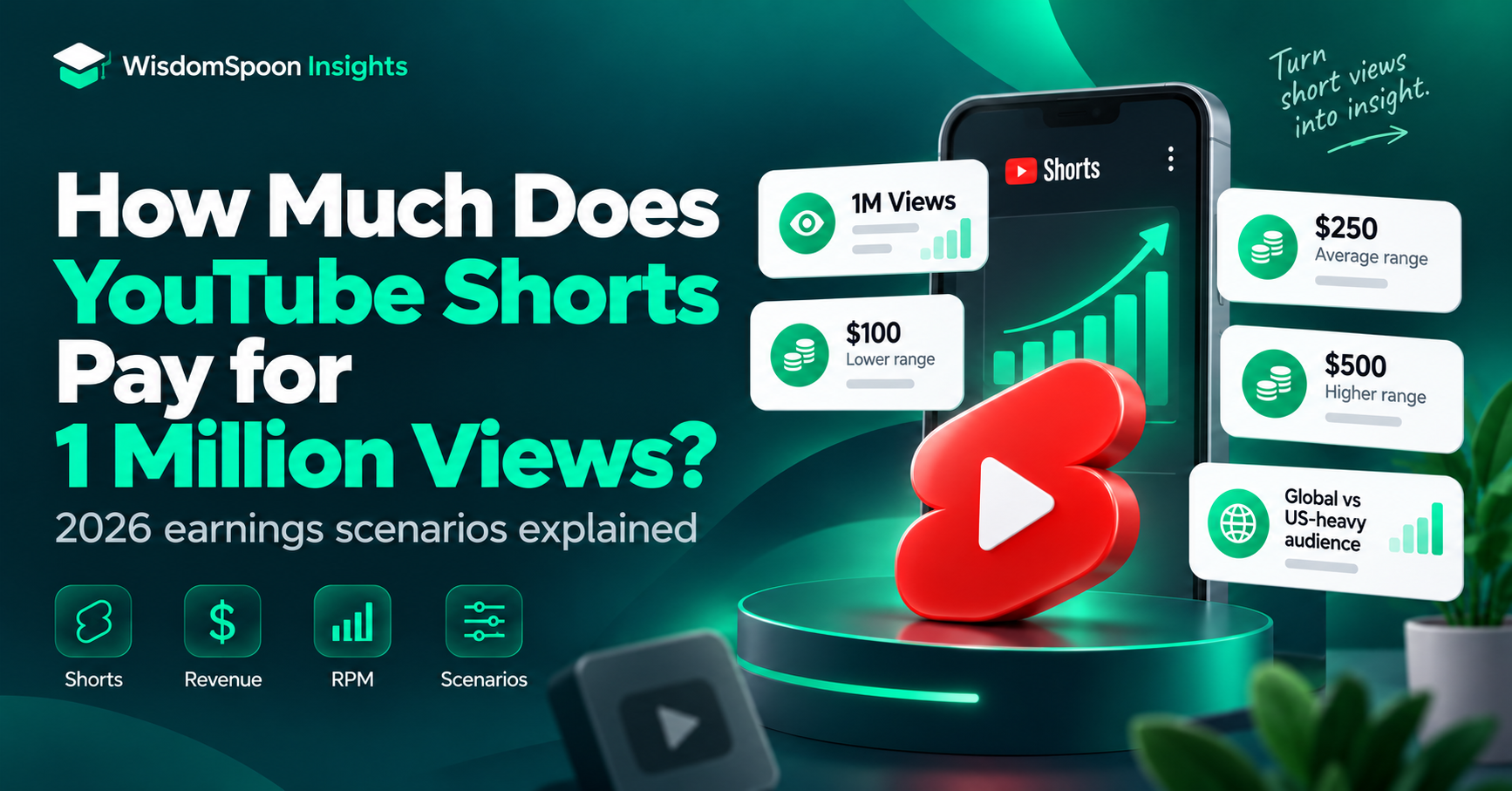
For many creators, one million Shorts views generates only a few hundred dollars in direct YouTube revenue.
Real-world partner data published by AIR Media-Tech in 2026 suggests that one million Shorts views from a strongly U.S.-based audience can generate around $300 in direct revenue, while a more globally mixed audience may commonly produce roughly $150–$250.
But there is an important complication in 2026:
A public Shorts view and a monetization-relevant engaged view are no longer necessarily the same thing.
So the real answer requires more than multiplying one million by a single rate.
The Quick Answer
If we use illustrative Shorts RPM scenarios, the math looks like this:
| Shorts RPM | Approx. revenue per 1 million engaged views |
|---|---|
| $0.03 | $30 |
| $0.05 | $50 |
| $0.10 | $100 |
| $0.15 | $150 |
| $0.20 | $200 |
| $0.30 | $300 |
| $0.50 | $500 |
| $1.00 | $1,000 |
These are mathematical scenarios, not fixed YouTube payment rates.
AIR Media-Tech’s 2026 study of 274 channels found Shorts RPMs ranging approximately from $0.02 to $1.48, depending heavily on niche and channel characteristics. Most non-music niches were clustered much lower than the top of that range.
For many channels, an outcome somewhere in the low hundreds of dollars per million Shorts views is therefore more realistic than the thousands sometimes associated with long-form YouTube traffic.
Why Shorts Pay So Differently From Long-Form YouTube
YouTube does not attach Shorts advertising revenue directly to an individual Short in the same way that watch-page advertising works for standard videos.
Instead, revenue from ads appearing between videos in the Shorts Feed is pooled.
YouTube then:
- collects eligible Shorts Feed advertising revenue;
- determines the Creator Pool;
- allocates revenue to monetizing creators based on their share of eligible engaged Shorts views in each country;
- and pays creators 45% of the revenue allocated to them.
This is fundamentally different from long-form watch-page advertising, where eligible creators currently receive 55% of net ad revenue from advertisements displayed or streamed on their public watch-page videos. Google Help
That difference in monetization structure is a major reason Shorts revenue per view is usually much lower.
One Million Public Views Is No Longer the Same as One Million Engaged Views
This distinction became especially important in August 2026.
Beginning August 24, 2026, YouTube changed public view counting so that a view is counted from the moment a video begins playing, starting with the first frame, across Shorts, long-form videos, live streams and other formats. Google Help
But YouTube explicitly says the change does not alter creator earnings.
YouTube Partner Program earnings continue to rely on engaged Shorts views and engaged watch hours rather than simply the public-facing view total.
So imagine your Short displays:
1,000,000 public views
That does not automatically mean YouTube is calculating your Shorts earnings from exactly one million monetization-relevant engaged views.
This is one reason earnings estimates based solely on the public counter should be treated cautiously.
What Is an Engaged Shorts View?
YouTube describes engaged views as views where people stayed to watch beyond the initial seconds, excluding loops.
That means the platform now effectively has two useful ideas:
Public views help describe exposure.
Engaged views are more relevant to performance and monetization.
For creators interested in earnings, the second metric is more useful.
So when analyzing Shorts monetization in 2026, YouTube Studio matters much more than the public view number underneath the Short.
Real 2026 Shorts RPM Data
AIR Media-Tech analyzed data from 274 channels across 13 niches, covering more than 3,000 channel-month data points.
The study found Shorts RPM ranging from approximately:
$0.02 to $1.48
depending on niche and channel size.
Examples included:
| Niche | Approx. Shorts RPM observed |
|---|---|
| Gaming | around $0.17 |
| Gadgets & Tech | around $0.13 |
| Crafting & Handmade | around $0.11 |
| Lifestyle | around $0.20–$0.23 |
| Kids & Teens | around $0.05–$0.11 |
| Music | around $0.97–$1.48 in some tiers |
Music was a significant outlier because Content ID and music-rights economics can affect monetization differently from ordinary Shorts channels.
For most creators outside music, the much lower figures are more relevant.
Geography Can Change 1 Million Shorts Views Dramatically
Viewer location is one of the biggest variables.
AIR reported the following audience-geography benchmarks from its partner data:
| Audience country | Shorts RPM |
|---|---|
| United States | $0.328 |
| Australia | $0.193 |
| United Kingdom | $0.166 |
| Canada | $0.165 |
| Germany | $0.163 |
| Brazil | $0.045 |
| Mexico | $0.040 |
| Philippines | $0.023 |
| Turkey | $0.024 |
| Indonesia | $0.012 |
| India | $0.008 |
The implication is enormous.
Example: U.S.-heavy audience
At roughly:
$0.328 RPM
one million relevant views correspond mathematically to:
about $328
Example: India-heavy audience
At roughly:
$0.008 RPM
one million relevant views correspond to:
about $8
Those numbers should not be treated as permanent national payout rates.
But they demonstrate why two Shorts with identical public view counts can generate radically different revenue.
Why Geography Has Such a Big Effect
Shorts Creator Pool revenue is allocated partly on a country-by-country basis.
YouTube says creators receive an allocation based on their share of eligible engaged Shorts views among monetizing creators in each country.
Advertising markets differ widely between countries.
Advertisers may pay much more to reach viewers in one market than another.
So a million viewers are not economically identical simply because the headline number is the same.
Scenario 1: 1 Million Views at $0.05 RPM
Suppose your effective Shorts RPM is:
$0.05
Then:
1,000,000 ÷ 1,000 × $0.05
= $50
That may sound extremely low for a million views.
But Shorts operate at enormous scale.
A creator may generate tens of millions of Shorts views in a relatively short period, particularly in globally broad entertainment categories.
Low revenue per view does not necessarily mean low total revenue.
Scenario 2: 1 Million Views at $0.15 RPM
At:
$0.15 RPM
one million relevant views correspond to:
$150
This falls within the broad range reported for many globally mixed audiences in real partner data. Air
At:
10 million views
the same rate would correspond to:
$1,500
Scale changes the economics.
Scenario 3: 1 Million Views at $0.30 RPM
At:
$0.30 RPM
one million relevant views would generate approximately:
$300
This is close to AIR’s reported example for a strongly U.S.-weighted Shorts audience. Air
At:
10 million views
that becomes:
$3,000
Again, the RPM remains low compared with many long-form channels.
But the enormous potential reach of Shorts can partially compensate.
Can 1 Million Shorts Views Earn $1,000?
Yes, mathematically.
To make:
$1,000
from:
1 million engaged views
you would need approximately:
$1 RPM
Some creator data does show Shorts RPM above $1 in certain circumstances, particularly in parts of the music niche. AIR’s dataset reported figures as high as approximately $1.48 in some Music channel groups.
But this should not be viewed as a typical Shorts outcome.
For many ordinary creator categories, Shorts RPM is far below $1.
Why Music Can Be Different
Music is a special case.
AIR found Music Shorts significantly outperforming many other categories on RPM, in part because of Content ID and rights-holder economics.
That means comparing a musician’s Shorts earnings with:
a gaming channel, lifestyle creator or education channel
may produce a misleading benchmark.
Even within the same format, niche matters.
Does Using Music Reduce Your Shorts Revenue?
The Shorts revenue model includes music licensing in the Creator Pool calculation.
YouTube explains that part of Shorts Feed revenue may be used to cover music licensing costs before the Creator Pool is allocated.
However, after the Creator Pool allocation is determined, monetizing creators keep 45% of the revenue allocated to them, regardless of whether music was used in the Short.
So the system is more complex than simply saying:
“Using a song cuts your payout in half.”
That is not how the final creator share works.
Why 1 Million Long-Form Views Can Be Worth So Much More
AIR’s wider 2026 long-form study found a median YouTube RPM of approximately:
$2.30 per 1,000 views
across 300 channels.
At that median:
1 million long-form views ≈ $2,300
By comparison, AIR estimated:
1 million Shorts views from a U.S.-heavy audience ≈ $300
and a mixed global audience often around:
$150–$250.
That difference explains why creators should not value one million Shorts views and one million long-form views equally.
AIR’s 274-channel research found that Shorts RPM was roughly 3% to 14% of long-form RPM in most niches, outside important exceptions such as music.
Does This Mean Shorts Are Not Worth Making?
No.
This is where direct revenue alone can be misleading.
A Short may generate only:
$100–$300
in direct advertising revenue.
But that same Short might:
- generate thousands of new subscribers;
- introduce viewers to your long-form videos;
- revive traffic to older content;
- increase brand visibility;
- attract sponsorship interest;
- generate affiliate sales;
- or help launch a product.
That broader value does not necessarily appear inside Shorts RPM.
So the business question is often not:
“How much did this Short pay?”
It is:
“What did this Short do for the rest of my channel?”
Shorts Can Be a Discovery Engine
AIR’s 2026 analysis summarized the strategic relationship neatly:
Shorts can bring people into the channel, while long-form can capture much more of the revenue.
Imagine a Short generates:
2 million views
and perhaps:
$300–$500 direct revenue
But it also sends:
100,000 additional views
to long-form content earning:
$4 RPM
Those additional long-form views could generate:
$400
on top of the direct Shorts income.
If viewers continue watching older videos afterward, the long-term value could increase further.
This is why Shorts should sometimes be evaluated as audience acquisition, not just as standalone ad inventory.
Subscriber Growth Can Also Have Value
A viral Short might add:
5,000
or:
50,000 subscribers
depending on the content and audience.
Those subscribers are not automatically valuable financially.
Some may never watch another video.
But if even part of that audience transitions into:
long-form viewers, livestream viewers, members or repeat viewers,
the Short can create value far beyond its immediate payout.
A low RPM does not necessarily mean low strategic value.
What About Sponsorships?
Brand deals are another reason the direct Shorts payout tells only part of the story.
A creator who consistently generates millions of Shorts views may become commercially attractive to brands.
That creator might earn:
$200 from Shorts advertising
but:
$2,000 from a sponsorship
associated with the same audience exposure.
The sponsorship income does not appear in standard Shorts RPM.
For commercially successful creators, platform ad revenue may represent only one part of the business.
Why Public View Counts Can Be Misleading for Earnings Estimates
The August 2026 view-counting change makes this particularly important.
Suppose two creators each show:
1 million public Shorts views
Creator A has a high proportion of engaged viewers.
Creator B receives many rapid starts but fewer people continue watching.
Their public exposure may look identical.
Their monetization-relevant viewing may not be.
YouTube says earnings continue to rely on engaged Shorts views, despite the broader public view-counting standard.
So in 2026, serious earnings analysis should prioritize:
YouTube Studio data over the public counter.
What Makes a Shorts View Eligible for Revenue Sharing?
Not every engaged Shorts view qualifies.
YouTube says ineligible views can include:
- artificial or fake views;
- non-original Shorts such as unedited reuploads;
- certain compilations without meaningful original content;
- and views on content inconsistent with advertiser-friendly guidelines.
This means a creator cannot simply manufacture large numbers of views and expect them all to generate Shorts Pool revenue.
Eligible engagement matters.
Why Two Creators With 1 Million Views Can Earn Completely Different Amounts
Imagine these two creators.
Creator A
1 million public Shorts views
Audience heavily concentrated in high-value advertising markets
Strong engaged-view rate
Original advertiser-friendly content
Effective RPM around:
$0.30
Potential revenue:
approximately $300
Creator B
1 million public Shorts views
Audience concentrated in lower-ad-spend markets
Lower engaged-view proportion
Effective RPM around:
$0.03
Potential revenue:
approximately $30
Same headline milestone.
Ten times the revenue difference.
That is why screenshots of creator earnings without geography and audience context are almost meaningless as benchmarks.
How Many Shorts Views Would You Need to Make $1,000?
The required traffic depends entirely on RPM.
At:
$0.05 RPM
you would need approximately:
20 million views
At:
$0.10 RPM
you would need approximately:
10 million views
At:
$0.20 RPM
you would need approximately:
5 million views
At:
$0.30 RPM
you would need approximately:
3.33 million views
At:
$0.50 RPM
you would need approximately:
2 million views
This demonstrates why direct Shorts monetization is largely a scale business.
Low RPM requires extraordinary traffic.
Should You Focus on Increasing Shorts RPM?
Only to a point.
Creators do not directly control advertiser demand or Creator Pool economics.
Trying to chase higher RPM by changing everything about your content can be counterproductive.
A stronger strategy is usually to optimize for:
- high-quality engaged viewing;
- strong audience retention;
- original content;
- advertiser suitability;
- repeat viewers;
- subscriber conversion;
- and movement into higher-value parts of the channel.
A creator with:
$0.10 RPM and 20 million views
may earn more than someone with:
$0.30 RPM and 2 million views.
Scale still matters.
Is One Million Shorts Views a Good Result?
Absolutely.
One million views represents substantial audience exposure.
The mistake is assuming that audience exposure automatically translates into enormous advertising revenue.
Shorts are built differently.
A million views can still provide:
brand awareness, subscribers, audience data, social proof, channel momentum and traffic to other content.
That value may ultimately be worth much more than the immediate Creator Pool payment.
The Practical Answer
So, how much does YouTube Shorts pay for 1 million views in 2026?
There is no single fixed amount.
Real creator data suggests that many channels may see earnings somewhere in the low hundreds of dollars, with AIR reporting approximately:
$300 for a U.S.-heavy audience
and roughly:
$150–$250 for many mixed global audiences.
But actual results can be much lower or higher depending on:
- audience geography;
- engaged views;
- niche;
- Creator Pool economics;
- advertiser demand;
- content eligibility;
- and revenue mix.
And because YouTube changed public view counting in August 2026, the visible one-million-view milestone should not automatically be treated as one million monetization-relevant engaged views.
The better question is therefore not simply:
“What does one million Shorts views pay?”
It is:
“What does one million Shorts views create for my entire channel?”
For many creators, that second number can be far more valuable.
Frequently Asked Questions
How much does YouTube Shorts pay for 1 million views?
There is no fixed rate. AIR Media-Tech reports approximately $300 for one million Shorts views from a U.S.-heavy audience and around $150–$250 for many mixed global audiences in its partner data.
Can 1 million YouTube Shorts views make $1,000?
It is possible but not typical for many niches. One million monetization-relevant views would require roughly a $1 Shorts RPM to generate $1,000. AIR’s 2026 dataset found some Music channels above this level, while most other niches were substantially lower.
What is a typical YouTube Shorts RPM?
There is no universal rate. AIR’s 274-channel 2026 study found Shorts RPM between approximately $0.02 and $1.48 depending on niche and channel characteristics.
Does YouTube pay 45% of Shorts ad revenue?
Creators receive 45% of the revenue allocated to them from the Shorts Creator Pool. The pool itself is created and allocated according to YouTube’s Shorts monetization rules.
Are public Shorts views used directly to calculate earnings?
Not necessarily. Since August 24, 2026, public views count from the moment playback begins, while YouTube says creator earnings continue to rely on engaged Shorts views.
Why do U.S. Shorts views often earn more?
Advertising demand differs by geography. AIR’s partner data reported a U.S. Shorts RPM around $0.328 compared with substantially lower figures in several large developing markets.
Do Shorts with music earn less?
Shorts Feed revenue is pooled partly to account for music licensing. YouTube says monetizing creators still keep 45% of the revenue allocated to them regardless of whether music was used.
Do 1 million Shorts views pay as much as 1 million long-form views?
Usually not. AIR’s 2026 study found Shorts RPM at approximately 3%–14% of long-form RPM in most niches.