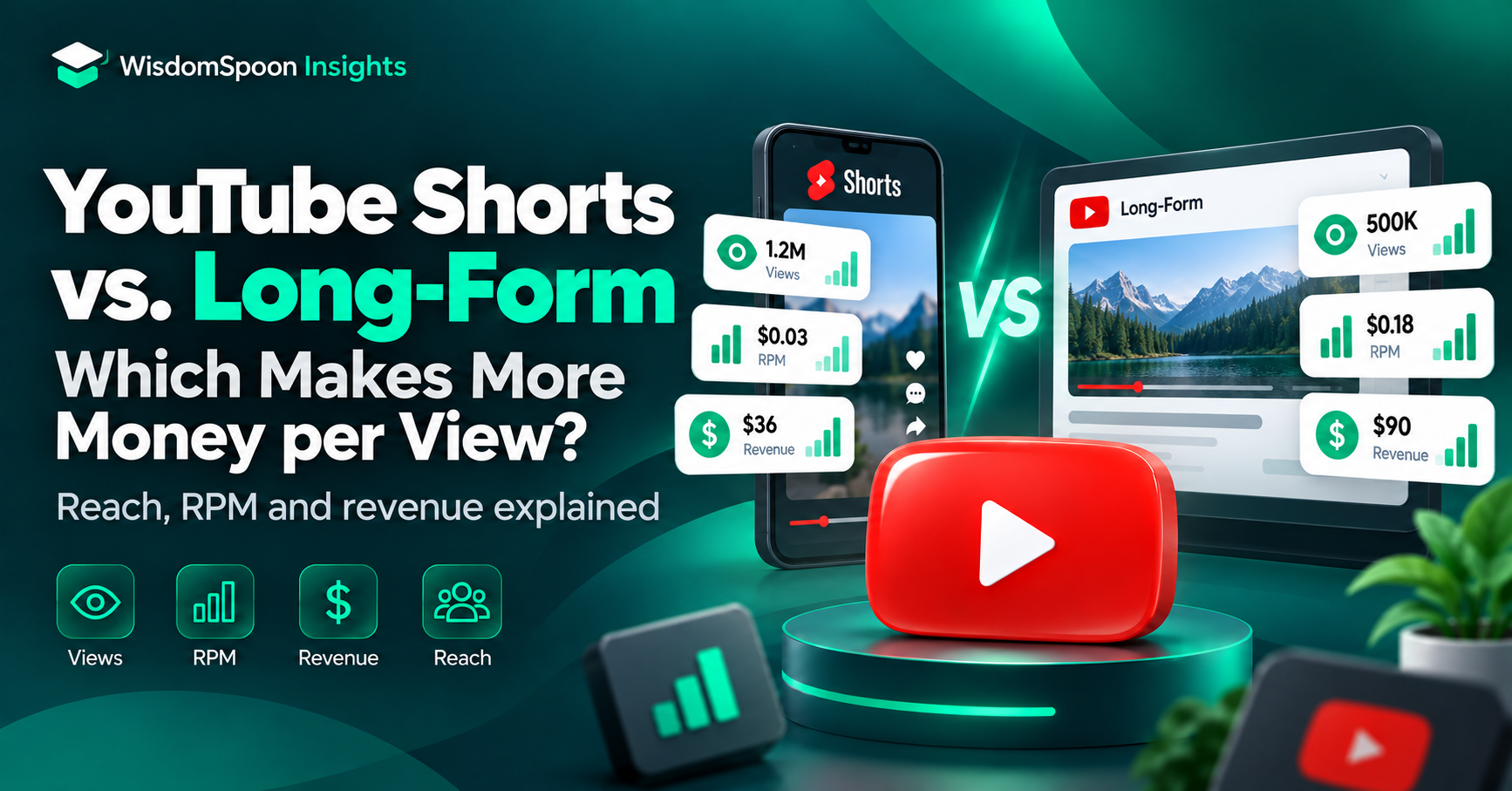
If a YouTube Short gets one million views and a long-form video gets one million views, will they earn roughly the same amount?
Usually, no.
In most cases, long-form YouTube views are worth substantially more in direct revenue than Shorts views.
But that does not mean Shorts are financially useless.
The two formats are monetized differently, serve different purposes in YouTube’s ecosystem, and can contribute to a creator’s business in very different ways.
Long-form tends to be stronger at revenue per view.
Shorts can be much stronger at reach, discovery and rapid audience growth.
Understanding that distinction is more useful than simply asking which format “pays better.”
The Short Answer
For direct monetization per view, long-form usually wins by a large margin.
A September 2026 analysis from AIR Media-Tech used YouTube Analytics data from 274 channels across 13 niches. It found that Shorts RPM was only about 3% to 14% of long-form RPM in most niches, with music as an important exception.
In practical terms, AIR estimated that many channels needed approximately:
11,000 to 34,000 Shorts views
to generate roughly the same direct revenue as:
1,000 long-form views.
That is a huge difference.
But direct RPM is only one way to measure the value of content.
Why Shorts and Long-Form Pay Differently
The biggest reason is structural.
YouTube does not monetize Shorts Feed views in the same way it monetizes standard watch-page videos.
For eligible long-form content under the Watch Page Monetization Module, YouTube currently pays creators 55% of net advertising revenue generated from ads displayed or streamed on their public watch-page videos.
Shorts use a different model.
Advertising revenue from ads shown between videos in the Shorts Feed is pooled. Revenue is then allocated through the Shorts Creator Pool based on eligible viewing, and creators currently receive 45% of the revenue allocated to them.
So the difference is not simply: 55% versus 45%.
The entire advertising system is different.
Long-form has ads associated with the viewing experience around individual videos.
Shorts advertising sits between content in a rapidly scrolling feed and is distributed through a pooled model.
That has major consequences for revenue per view.
What RPM Tells Us
RPM stands for Revenue Per Mille, or creator revenue per 1,000 views.
It is useful because it translates traffic into a comparable earnings measure.
Suppose a long-form channel has:
$4 RPM
Then:
100,000 views ≈ $400
Now imagine its Shorts RPM is:
$0.15
Then:
100,000 Shorts views ≈ $15
The same public traffic count can therefore represent dramatically different direct revenue.
This is why claims such as:
“My Short got a million views”
and:
“My video got a million views”
do not necessarily describe comparable financial outcomes.
What Real 2026 Data Shows
AIR’s September 2026 study found that Shorts RPM generally clustered far below long-form RPM.
Across its dataset, Shorts RPM ranged from approximately:
$0.02 to $1.48
depending on niche, channel size and other factors.
For many non-music categories, reported Shorts RPMs were much closer to the lower end of that range.
Examples from AIR’s dataset included roughly:
| Content type | Example Shorts RPM |
|---|---|
| Gaming | around $0.17 |
| Gadgets & Tech | around $0.13 |
| Crafting & Handmade | around $0.11 |
| Kids & Teens | roughly $0.05–$0.11 |
| Lifestyle | roughly $0.20–$0.23 |
Music was an unusual case, with Shorts RPM in some channel-size groups reaching approximately $0.97 to $1.48, partly because music monetization has additional Content ID dynamics.
These figures are sample benchmarks, not official universal YouTube payout rates.
Your own results can be higher or lower.
One Million Views: Shorts vs. Long-Form
Consider a simplified comparison.
Long-form example
Views:
1,000,000
RPM:
$4
Estimated revenue:
$4,000
Shorts example
Views:
1,000,000
RPM:
$0.15
Estimated revenue:
$150
Same headline view count.
Very different direct revenue.
AIR reported that a million Shorts views from a U.S.-heavy audience could generate roughly $300 in direct revenue, while a more globally mixed audience could commonly fall around $150–$250 in its dataset.
Again, these are observed examples rather than guaranteed rates.
But they illustrate why creators should not value Shorts and long-form views equally.
A 2026 Warning About the Word “View”
There is now another complication.
Beginning August 24, 2026, YouTube changed its public view-counting system across Shorts, long-form videos, live streams and other formats.
A public view is now counted when a video begins playing from the first frame.
But this change did not change how creator earnings are calculated.
YouTube says Partner Program earnings continue to rely on metrics such as engaged views and engaged watch hours rather than simply the new public-facing view number.
This means creators comparing public view counts with revenue need to be especially careful in 2026.
A million displayed views are useful for measuring exposure.
They are not necessarily a million equivalent monetization events.
Why Long-Form Usually Earns More
Long-form video has several structural advantages for direct monetization.
A viewer may spend five, ten, twenty or forty minutes watching one video.
That creates opportunities for ads before, during, after and around content.
Eligible monetized videos that are at least eight minutes long can also use mid-roll advertising opportunities.
The longer viewing session can therefore generate considerably more advertising inventory than a rapid Shorts Feed interaction.
Long-form content can also create a stronger environment for:
- product consideration;
- affiliate conversions;
- sponsorship integration;
- memberships;
- deeper viewer trust;
- and returning audiences.
The direct RPM comparison therefore understates some of long-form’s broader commercial advantages.
Why Shorts Can Still Be Extremely Valuable
If Shorts earn much less per view, why do creators use them?
Because reach has value too.
Shorts can place content in front of enormous audiences very quickly.
A creator may struggle to generate 100,000 long-form views but receive millions of Shorts views.
That changes the calculation.
Imagine:
Creator A — Long-form
200,000 views
$5 RPM
Revenue:
$1,000
Creator B — Shorts
10 million views
$0.15 RPM
Revenue:
$1,500
Creator B has a dramatically lower revenue rate.
But sheer traffic volume compensates for it.
The lower-paying format still generates more direct revenue because it produces fifty times as many views.
This is why RPM and scale must always be considered together.
Shorts Are Often Better Viewed as Discovery
AIR’s 2026 analysis reached an important conclusion:
For many creators, the strongest economic role of Shorts may not be the revenue generated by the Shorts themselves.
It may be the viewers they bring into the wider channel.
AIR summarized the dynamic as:
Shorts bring viewers to the channel; long-form captures the revenue.
One case in its study involved an Arts & Crafts channel that began publishing Shorts after its broader performance weakened.
Over the following 30 days:
views increased by about 41.8%
while revenue increased by about 64.1%.
AIR reported that the Shorts themselves generated very little direct revenue; the larger financial effect came from renewed distribution and increased viewing of existing long-form content.
That is a very different way to think about Shorts.
Instead of asking:
“How much did this Short pay?”
you may need to ask:
“What did this Short cause people to watch next?”
Revenue per View vs. Revenue per Viewer
Long-form content has another advantage that RPM alone does not fully capture.
A person who spends twenty minutes watching your content may become:
a subscriber, a repeat viewer, an affiliate customer, a member, or a buyer of a product or service.
A person who watches a ten-second Short may never interact with the channel again.
That does not make the Shorts viewer worthless.
It means the relationship is different.
Long-form often provides more time to:
explain, demonstrate, persuade and build familiarity.
For creators building businesses rather than merely collecting views, that depth can be extremely valuable.
Shorts Can Grow Subscribers Faster
Shorts can be exceptionally effective at exposure and subscriber acquisition.
The feed allows YouTube to test content with large numbers of viewers without requiring them to search for the creator first.
A well-performing Short can therefore introduce a channel to people who would never have discovered a twenty-minute video from that creator.
This is particularly useful for:
new channels, personality-driven creators, entertainment, visual demonstrations, transformations, tips, clips and highly shareable concepts.
But subscriber growth alone does not guarantee revenue growth.
The crucial question is whether Shorts viewers eventually become meaningful long-form viewers or customers.
The Danger of Looking Only at Subscribers
Imagine a channel gains:
100,000 subscribers from Shorts
but those subscribers rarely watch its long-form videos.
Another channel gains:
20,000 subscribers from long-form
and those viewers regularly watch twenty-minute videos.
Which audience is more valuable?
There is no universal answer.
But subscriber count alone cannot tell you.
You need to examine:
long-form views, returning viewers, revenue, watch behavior and cross-format conversion.
A large Shorts-driven subscriber number can look impressive publicly while contributing relatively little long-term watch-page revenue.
Does Posting Shorts Hurt Long-Form Revenue?
This question is more complicated.
AIR’s September 2026 dataset found different patterns in different niches.
Gaming showed relatively stable long-form RPM whether channels used Shorts or not.
Entertainment showed a much stronger negative association between heavy Shorts publishing and long-form RPM in the dataset. AIR emphasized that the research showed correlation, not proof that Shorts caused the decline.
That distinction is important.
Shorts may attract a different audience.
Channels posting many Shorts may also operate differently in other ways.
YouTube’s recommendation systems may respond differently depending on audience behavior.
So creators should not conclude:
“Shorts destroy long-form channels.”
Nor should they assume:
“Shorts can never affect the economics of my channel.”
The sensible approach is to monitor your own data.
When Shorts Make the Most Sense
Shorts can be especially useful when the format naturally matches the content.
For example:
a striking transformation, quick tutorial, memorable quote, gaming moment, music clip, product demonstration, comedy scene or strong visual idea.
The key is that the Short should work as content in its own right.
Simply cutting random pieces from a long-form video and flooding the Shorts Feed may produce views without creating meaningful audience interest.
The best Shorts strategy is usually intentional.
When Long-Form Makes the Most Sense
Long-form is usually stronger when the subject requires:
explanation, storytelling, education, comparison, analysis, demonstrations, reviews, interviews or deeper entertainment.
It also becomes particularly valuable when monetization matters heavily.
Creators whose audiences have strong commercial value may give up substantial revenue if they shift too much attention from high-RPM long-form videos to low-RPM Shorts.
This is particularly relevant in niches where long-form RPM is already strong.
Should You Choose Shorts or Long-Form?
For many creators, this is the wrong question.
You may not need to choose one format exclusively.
A better question is:
What job should each format do?
Long-form can be the core product.
Shorts can be the discovery layer.
A Short introduces the creator.
A long video builds the relationship.
The long video generates deeper monetization.
Another Short brings in another new viewer.
When that system works, the formats complement rather than compete with each other.
A Mixed Strategy Can Be Powerful
AIR’s 2026 dataset suggested that moderate Shorts usage often produced better outcomes than either avoiding Shorts entirely or shifting heavily toward them.
Its analysis identified a mixed strategy around roughly one Short for every two to three long-form uploads as a potentially strong zone across many niches, although the exact result varied by category and channel.
This should not be treated as a universal posting formula.
A gaming creator, educator, musician and entertainment channel may need completely different approaches.
But it does reinforce a useful idea:
You do not necessarily need to become a Shorts channel to benefit from Shorts.
How to Judge Whether Shorts Are Working for Your Channel
The answer should not come from Shorts views alone.
Watch what happens to the rest of the channel.
If you begin publishing Shorts and see:
more subscribers, more returning viewers, stronger long-form views and increased total revenue,
the strategy may be working even if Shorts RPM looks terrible.
If Shorts views explode but:
long-form views stagnate, revenue does not grow and new subscribers never watch anything else,
then the apparent growth may be less valuable than it looks.
The goal is not maximum Shorts views.
The goal is useful audience growth.
Which Format Makes More Money per View?
For direct creator revenue per view, the answer in 2026 is generally clear:
Long-form YouTube videos usually make significantly more money per view than Shorts.
AIR’s 274-channel dataset found Shorts RPM at only around 3% to 14% of long-form RPM in most niches, with music as a notable exception.
But that does not make long-form automatically superior in every situation.
Shorts can generate:
much larger reach, faster discovery, rapid subscriber growth and traffic that later flows into higher-value long-form content.
So the two formats solve different problems.
The Important Takeaway
If your primary goal is:
direct revenue per view
long-form is usually the stronger format.
If your primary goal is:
reach and discovery
Shorts can be extremely powerful.
If your goal is:
building a sustainable creator business
the strongest strategy may combine both.
Think of it this way:
Shorts can open the door.
Long-form can give viewers a reason to stay.
And in many creator businesses, the viewers who stay are ultimately the ones who generate the greatest long-term value.
Frequently Asked Questions
Do YouTube Shorts earn less than long-form videos?
Generally yes. AIR’s September 2026 analysis found that Shorts RPM was approximately 3% to 14% of long-form RPM in most niches.
How much does YouTube pay for 1 million Shorts views?
There is no universal rate. AIR reported roughly $300 for one million Shorts views from a U.S.-heavy audience in its partner data, while mixed global audiences often produced roughly $150–$250. Results vary substantially.
Does YouTube pay 55% for long-form videos?
For eligible watch-page advertising, YouTube currently pays creators 55% of net advertising revenue under the Watch Page Monetization Module.
What percentage does YouTube pay for Shorts?
For Shorts Feed advertising under the current model, creators receive 45% of the revenue allocated to them through the Shorts Creator Pool.
Why is Shorts RPM so much lower?
Shorts use a pooled feed-advertising model rather than the watch-page advertising structure used by long-form videos. Viewing sessions and available advertising opportunities are also very different.
Can Shorts increase long-form revenue?
They can. Shorts may introduce new viewers who later watch long-form content. AIR documented channel cases where Shorts coincided with stronger overall views and revenue even though direct Shorts RPM was low.
Should a new YouTube channel focus on Shorts?
It depends on the content and business goal. Shorts can be excellent for discovery, but creators interested in stronger revenue per view should generally also build long-form content.
Do public Shorts views equal monetized views?
Not necessarily. Since August 24, 2026, public views are counted from the moment playback begins across YouTube formats, while monetization continues to rely on engaged and qualified metrics.