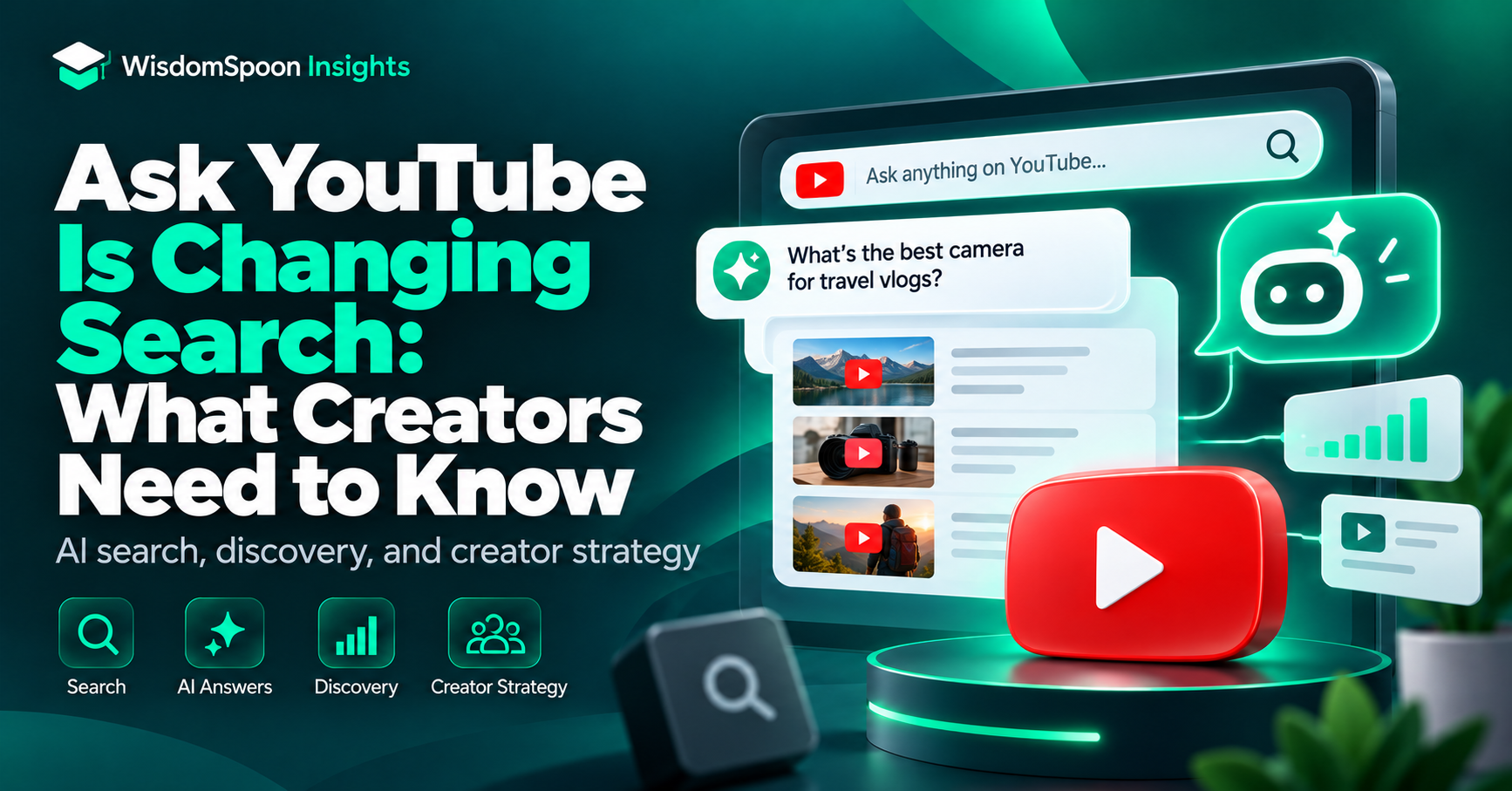
YouTube search has traditionally worked in a familiar way.
A viewer types something into the search bar.
YouTube returns a list of videos.
The viewer examines titles and thumbnails, chooses one, and starts watching.
That model is beginning to change.
With Ask YouTube, viewers can now ask YouTube a complete question and receive a structured response combining written information, long-form videos, Shorts and relevant moments taken from individual videos.
Instead of searching:
fix scratched painted wall
someone might ask:
How can I remove marks from a painted wall without damaging the paint?
And instead of simply returning ten videos, YouTube can attempt to answer the question, surface relevant videos and even direct the viewer to the part of a video that addresses the problem.
For viewers, this may make YouTube search faster and more conversational.
For creators, it could represent something much bigger:
YouTube may increasingly search inside videos, not merely rank the videos themselves.
That means the next phase of YouTube SEO may be less about convincing an algorithm that your video concerns a subject and more about making it easy for YouTube to understand exactly what questions your video answers and where those answers appear.
What Is Ask YouTube?
Ask YouTube is YouTube’s conversational search experience.
Instead of being limited to traditional keyword searches, viewers can ask longer and more complicated questions in natural language.
YouTube can then create a structured response using information from:
- long-form videos;
- Shorts;
- specific video clips;
- written information;
- and real-time information from the web.
Viewers can also ask follow-up questions.
For example, someone researching a trip could initially ask:
What should I do on a three-day road trip from San Francisco to Santa Barbara?
They could then continue:
Which stops are best for families?
or:
Where should I stop for coffee?
This moves YouTube search closer to a conversation rather than a sequence of isolated keyword searches.
Ask YouTube Is No Longer Just a Small Experiment
Ask YouTube began as a limited experiment but expanded significantly during 2026.
As of October 2026, YouTube says the search experience is available to users in the United States searching in English across:
- computers;
- mobile devices;
- and televisions.
YouTube has also been expanding conversational AI directly on video watch pages.
In June 2026 alone, more than 140 million people reportedly used Ask YouTube on the watch page.
That figure matters because it suggests conversational interaction with YouTube content is no longer something creators can dismiss as a niche test.
The exact form of the feature will almost certainly continue evolving.
But the direction is becoming clearer:
YouTube wants viewers to be able to ask questions about its enormous video library rather than manually browse through it.
Standard YouTube Search Is Not Disappearing
Creators should not interpret Ask YouTube as the end of conventional YouTube search.
YouTube has explicitly said that standard search remains available.
Viewers can still search normally and receive the familiar list of video results.
Ask YouTube currently complements that system.
However, even if traditional search remains, conversational search introduces a new discovery layer.
Previously, a creator primarily competed for a position such as:
the first, second or third video in search results.
Now a creator may also compete to become:
the video segment YouTube selects to answer the question itself.
That is an important difference.
YouTube Can Surface a Specific Moment Inside Your Video
This may be the most significant development for creators.
Ask YouTube does not necessarily need to recommend an entire video from the beginning.
It can identify a relevant section and present the viewer with a clip beginning around the moment most relevant to the question.
Imagine a 20-minute video titled:
How to Start a YouTube Channel in 2026
The video might contain sections covering:
- choosing a niche;
- selecting equipment;
- setting up a channel;
- creating thumbnails;
- improving retention;
- and monetization.
Someone asks:
What equipment do I actually need to start a YouTube channel?
Ask YouTube may not treat the entire 20-minute video as one unit.
It can attempt to identify the specific section discussing equipment.
That creates a potentially important new idea:
Every useful section of a video can become a discovery opportunity.
The Video May No Longer Be the Smallest Searchable Unit
Traditional creator SEO thinking usually treats the video as the primary unit.
Creators optimize:
- the title;
- thumbnail;
- description;
- topic;
- keywords;
- and audience response.
Ask YouTube adds another possible layer:
the segment.
A ten-minute video might contain five distinct answers.
A 30-minute tutorial might contain 15.
A podcast could contain dozens.
If YouTube becomes increasingly capable of understanding individual moments within videos, creators may need to think about content in a more structured way.
Instead of asking:
What is this video about?
also ask:
What questions does each part of this video answer?
How Does Ask YouTube Choose Videos?
YouTube says the Ask YouTube ranking system works similarly to conventional search and prioritizes:
- relevance;
- engagement;
- and quality.
It then attempts to identify clips that directly answer the viewer’s question.
This is important because it means Ask YouTube is not simply an AI system randomly extracting information from videos.
The underlying strength of the content still matters.
A video that is highly relevant but poorly received may struggle.
A popular video that does not clearly address the user’s question may also lose out.
The opportunity appears to sit where three things meet:
Relevant content + useful content + clearly identifiable answers
Chapters May Become More Important
YouTube specifically recommends clear video chapters when discussing how creators can improve their chances of appearing within Ask YouTube.
That should attract creators’ attention.
Video chapters traditionally help viewers navigate longer videos.
Under conversational search, they may also help YouTube understand the internal structure of a video.
Consider two chapter systems.
The first:
00:00 Introduction
03:21 Part Two
07:42 More Information
11:16 Final Thoughts
The second:
00:00 Why YouTube RPM Matters
03:21 How YouTube RPM Is Calculated
07:42 Why Your RPM Can Suddenly Drop
11:16 Ways to Improve YouTube Revenue
Which tells YouTube more?
Almost certainly the second.
It tells viewers more as well.
The important lesson is not to stuff chapter titles with keywords.
It is to make them descriptive enough that both viewers and systems can understand what each section contains.
Descriptive Titles Still Matter
AI search does not make titles irrelevant.
Quite the opposite.
YouTube specifically continues to recommend descriptive video titles.
If someone asks:
Why did my YouTube RPM suddenly drop?
a video titled:
Why Did My YouTube RPM Drop? 10 Things to Check
communicates its relevance clearly.
A title such as:
THIS CHANGED EVERYTHING!
may perform well in certain recommendation environments if the thumbnail and existing audience create curiosity.
But it provides far less information about what question the video answers.
This does not mean every title must become boring or purely functional.
Creators still need curiosity and click appeal.
But there may be increasing value in titles that balance:
clarity + curiosity
rather than curiosity alone.
Video Descriptions May Become More Useful Again
Creators have sometimes treated video descriptions almost as an afterthought.
That is risky.
YouTube’s own guidance continues to recommend unique descriptions that clearly explain the video and use the language viewers are likely to search for.
If AI systems are trying to understand your content deeply, a useful description provides another signal.
A good description should make it clear:
- what the video covers;
- who it is intended for;
- what problem it solves;
- and what major questions are addressed.
This does not require a 1,000-word SEO essay underneath every video.
Clear information is more useful than keyword repetition.
The Transcript May Become an Increasingly Important Asset
Even without Ask YouTube, YouTube already understands substantial amounts of spoken content.
Conversational search makes the actual words spoken inside a video even more strategically interesting.
Suppose someone asks:
Can a YouTube channel with 10,000 subscribers make $1,000 a month?
A creator whose video explicitly says:
“Yes, but subscriber count alone does not determine income. At a $5 RPM, approximately 200,000 monthly views would generate $1,000 before other income sources.”
has provided a clear, self-contained answer.
Another creator might discuss the same subject for ten minutes without ever answering the question directly.
The first piece of content is easier for a human to understand.
It may also be easier for an AI system to identify as useful.
This Could Reward Creators Who Answer Questions Clearly
For years, creators have sometimes stretched answers because longer videos can create more watch time.
A viewer searches:
How do I disable this setting?
and gets:
- a 45-second introduction;
- a channel promotion;
- a story;
- background information;
- and eventually the answer at minute five.
That experience becomes increasingly vulnerable in an AI-search environment.
If YouTube can identify the exact moment containing the answer, viewers may simply jump there.
Or YouTube may surface a competing creator who answers the question more efficiently.
Creators therefore have a growing incentive to make useful information easy to locate.
That does not mean every video must be short.
Long-form content can remain extremely valuable.
It means long videos should have structure.
Could Ask YouTube Reduce Video Clicks?
This is one of the biggest unanswered questions.
If Ask YouTube can provide a written answer directly in the search experience, some viewers may obtain enough information without watching a full video.
Consider a very simple question:
How many teaspoons are in a tablespoon?
If the answer appears instantly, many viewers have little reason to watch a five-minute video.
This resembles the concern publishers have raised around AI-generated summaries in web search.
However, YouTube is not identical to web search.
Much video content has value that cannot easily be compressed into a sentence.
For example:
- a repair demonstration;
- a cooking technique;
- a software walkthrough;
- a product comparison;
- an exercise;
- a travel experience;
- a documentary;
- a review;
- or a complex explanation.
In those cases, an AI answer may actually help the viewer identify which video is worth watching.
So Ask YouTube could simultaneously:
reduce clicks for some simple informational content
while:
create new discovery opportunities for richer content.
We do not yet have enough evidence to know the net effect across creators.
The Important Question Is Not “Will AI Steal My Views?”
That framing is too simple.
A better question is:
What type of content becomes more valuable when AI can understand and summarize videos?
If your entire video exists to communicate one fact that can be expressed in a single sentence, AI search creates an obvious challenge.
If your video provides:
- demonstration;
- evidence;
- personality;
- experience;
- examples;
- visual comparison;
- original research;
- entertainment;
- or deeper analysis;
then the AI answer may function more like a doorway.
This distinction could become increasingly important.
Tutorials Could Be Major Winners — With One Condition
Tutorial channels are particularly interesting.
They naturally answer specific questions.
Examples include:
How do I reset a Peugeot tyre pressure warning?
How do I calculate YouTube RPM?
How do I remove a background in Photoshop?
How do I replace a leaking tap?
This content aligns strongly with conversational search.
But creators need to make the useful moment easy to identify.
A strong tutorial might therefore use:
- a precise title;
- a short explanation of the problem;
- visible steps;
- descriptive chapters;
- clear verbal instructions;
- and a demonstration of the result.
The opportunity is not simply to rank a tutorial.
It is to become the source YouTube chooses when answering the question.
Educational Channels May Also Benefit
Educational creators frequently cover complex questions that cannot be answered adequately in one line.
Someone might ask:
Why did the Roman Empire collapse?
or:
Why does inflation make interest rates rise?
or:
How does photosynthesis actually work?
Ask YouTube can provide a summary, but viewers interested in understanding the subject may still want deeper explanations.
The AI response could therefore expose them to creators they would never otherwise encounter.
This creates an intriguing possibility for smaller channels.
Could Ask YouTube Help Smaller Creators?
Potentially.
Traditional YouTube search has always considered relevance and engagement rather than simply ranking the biggest channel.
Ask YouTube adds another variable:
Does a specific moment in this video answer the question particularly well?
That could give smaller creators an opportunity.
Imagine:
Channel A: 2 million subscribers
Channel B: 18,000 subscribers
Channel A has a broad video that mentions the subject briefly.
Channel B has a detailed tutorial with a section precisely answering the viewer’s question.
If YouTube prioritizes the strongest answer, Channel B may have a discovery opportunity it previously lacked.
That should not be interpreted as a guarantee.
YouTube has not published a formula showing how channel size affects Ask YouTube visibility.
But it reinforces a useful principle:
specific usefulness can compete with scale.
What Happens to Traditional YouTube SEO?
It does not disappear.
Traditional YouTube SEO remains highly relevant.
YouTube still considers how titles, descriptions and the content itself match viewer searches.
Engagement continues to matter.
Quality continues to matter.
But SEO may become more conversational.
Creators historically optimized around phrases such as:
YouTube RPM
Now viewers may ask:
Why is my YouTube RPM lower this month even though my views increased?
Those are different types of searches.
The second reveals a specific problem.
Creators who understand the questions behind keywords may have an advantage.
Think in Questions, Not Just Keywords
This is perhaps the most useful strategy creators can adopt immediately.
Suppose your core keyword is:
YouTube sponsorship rates
Instead of building content only around that phrase, identify related questions:
- How much should a 10K YouTuber charge for a sponsorship?
- Should sponsorship prices be based on subscribers or average views?
- What should a YouTube sponsorship package include?
- How much does a 60-second integration cost?
- Should creators charge extra for exclusivity?
- What if a sponsor asks for usage rights?
Now your video does not merely target a keyword.
It builds a question map around the subject.
That approach fits naturally with conversational search.
One Video Can Answer Multiple Search Questions
This creates another opportunity.
Creators do not necessarily need to publish separate videos for every tiny query.
A strong, structured long-form video can contain several meaningful sections.
For example:
How YouTube Sponsorship Pricing Really Works
could contain chapters such as:
00:00 How YouTube sponsorship pricing works
02:10 Subscribers vs. average views
05:30 Calculating a base sponsorship rate
08:20 Charging for exclusivity
11:15 Usage rights and licensing
14:00 When to negotiate
Each section potentially addresses a different conversational query.
That may make well-structured long-form content even more valuable.
Do Not Turn Videos Into AI Bait
Whenever a search system changes, people try to manipulate it.
We are likely to see advice such as:
- repeat the question five times;
- add hundreds of AI keywords;
- create dozens of artificial chapters;
- stuff descriptions with questions;
- manufacture transcripts for algorithms.
That is unlikely to be a durable strategy.
YouTube explicitly says Ask YouTube considers relevance, engagement and quality.
And YouTube’s broader monetization policies increasingly emphasize original, authentic content rather than generic or mass-produced material.
Creators should therefore optimize for clarity, not manipulation.
The best question to ask is:
Would this structure make the video easier for a real viewer to understand?
If yes, it is probably useful.
A Practical Ask YouTube Optimization Checklist
Creators do not need to rebuild their channels overnight.
Start with your most valuable searchable videos.
For each one, check:
Title
Does the title clearly communicate what problem or question the video addresses?
Opening
Does the viewer quickly understand what the video will answer?
Structure
Does the video move logically from one question or step to another?
Chapters
Do chapter titles describe what each section actually covers?
Description
Does the description clearly explain what the viewer will learn?
Language
Do you answer important questions directly rather than burying the answer inside unnecessary filler?
Visual value
Does the video demonstrate something that a written AI answer cannot fully replace?
Depth
After giving the direct answer, do you provide examples, context, comparison or experience that gives viewers a reason to continue watching?
This is not just Ask YouTube optimization.
It is good content design.
Start With Your Existing Search Winners
There is no need to update hundreds of videos immediately.
Start with perhaps your top five or ten videos receiving traffic from YouTube Search.
Look at the search terms bringing people to those videos.
Then ask:
What exact questions are these viewers trying to answer?
Review whether your:
- title;
- description;
- chapters;
- spoken explanation;
- and video structure
make those answers obvious.
This turns Ask YouTube preparation into a manageable experiment rather than a complete channel overhaul.
Watch for Changes in Search Traffic
Creators should also monitor analytics.
If Ask YouTube becomes a larger part of discovery, useful signals may include:
- changes in YouTube Search traffic;
- unusual growth in older tutorial videos;
- increased traffic entering at specific timestamps;
- shifts in average view duration;
- different search terms;
- and changes in viewer behavior around structured content.
YouTube has said that qualifying views generated from Ask YouTube are treated like normal views and can count toward overall metrics and Partner Program eligibility.
So creators should treat Ask YouTube as another discovery path rather than an entirely separate content ecosystem.
Ask YouTube Could Change What “Ranking First” Means
For years, creators have wanted the number-one search position.
But conversational search may make that concept less important.
Imagine someone asks:
What is the best microphone for YouTube videos under $100?
Ask YouTube could potentially build an answer using information or clips from several creators.
One video might provide:
the best budget choice
another:
the best microphone for noisy rooms
and another:
the best choice for mobile creators.
Discovery may therefore become more fragmented.
Instead of one winner owning the search query, several creators could contribute different pieces of the answer.
That could create both more competition and more opportunity.
Creators Need to Provide Something AI Cannot Replace
This may ultimately be the biggest strategic lesson.
If AI can summarize information, creators need to ask:
Why should the viewer still watch me?
Possible answers include:
- because I demonstrate the process;
- because I tested the products myself;
- because I have original data;
- because I explain the nuance;
- because viewers trust my judgment;
- because I make the subject entertaining;
- because I have experience;
- because I show the outcome;
- or simply because viewers enjoy spending time with me.
The creator economy has never been only about information.
It is also about:
trust, personality, experience and perspective.
Those qualities may become more valuable as basic information becomes easier to generate.
This Could Favor Original Research and First-Hand Experience
Suppose 100 channels repeat the same advice.
An AI system can summarize that advice easily.
Now suppose one creator performs an original experiment:
I tested 20 YouTube thumbnails across 50 videos and here is what happened.
That content contains something different.
The creator is not merely packaging existing information.
They are producing new information.
Likewise:
I tested five microphones.
I stayed at 20 budget hotels.
I analyzed 300 channels.
I tried this strategy for 90 days.
First-hand experience produces material that AI search still needs sources to obtain.
That could become a stronger competitive advantage.
The Future of YouTube SEO May Be Answer Engine Optimization
The phrase “answer engine optimization” is increasingly being used around AI search more broadly.
For YouTube creators, the principle is straightforward.
Old thinking:
How do I rank my video for this keyword?
Emerging thinking:
How do I make my video the best source for answering this question?
That is a healthier strategy anyway.
It focuses on usefulness rather than tricks.
If YouTube continues integrating AI more deeply into search, creators who structure content around real viewer problems should be well positioned.
What Creators Should Do Now
There is no reason to panic.
Ask YouTube is still evolving.
Its availability remains geographically limited, features will change, and we do not yet have enough independent performance data to know precisely how it will affect overall creator traffic.
But creators do not need to wait before making sensible improvements.
The best steps today are surprisingly simple:
- Create content around genuine viewer questions.
- Give videos descriptive but appealing titles.
- Organize longer videos into logical sections.
- Use meaningful chapter names.
- Write useful descriptions.
- Answer important questions clearly.
- Demonstrate what text alone cannot communicate.
- Add original experience, examples or data.
- Build videos that remain useful even if AI summarizes the basic answer.
- Continue prioritizing viewer satisfaction over algorithm tricks.
None of these strategies depends on predicting exactly where Ask YouTube goes next.
They improve content either way.
The Bigger Shift
Ask YouTube is part of a broader change in how people find information.
Search is moving from:
“Give me documents or videos related to these words.”
toward:
“Understand what I am trying to do and help me accomplish it.”
For creators, that changes the competition.
Your video is no longer competing only against other thumbnails.
Parts of your video may compete to become the best answer to a specific question.
At the same time, your content could be discovered for questions you never explicitly targeted in the title.
That is both a threat and an opportunity.
Creators who merely repeat basic information may find it harder to stand out.
Creators who produce clear, structured, original and genuinely useful content could gain entirely new discovery paths.
Ask YouTube does not mean the death of YouTube search.
It may represent the beginning of a different kind of search.
And creators who understand that difference early may have an advantage.
Frequently Asked Questions
What is Ask YouTube?
Ask YouTube is YouTube’s conversational AI search experience. It can respond to natural-language questions using text, long-form videos, Shorts and relevant video clips.
Is Ask YouTube replacing normal YouTube Search?
No. YouTube says standard search remains available. Ask YouTube currently complements the existing search experience.
Where is Ask YouTube available?
As of October 2026, YouTube says Ask YouTube search is available to users in the United States searching in English across computers, mobile devices and supported TV platforms, with availability continuing to expand.
Can Ask YouTube show clips from my videos?
Yes. Ask YouTube can surface relevant video moments and display the video’s title and channel information.
Do views from Ask YouTube count as YouTube views?
YouTube says qualifying views from videos, Shorts and previews surfaced through Ask YouTube count toward normal view metrics and YouTube Partner Program eligibility.
How can creators increase their chances of appearing?
YouTube recommends continuing to create unique, high-quality content while using clear video chapters and descriptive titles. Relevance, engagement and quality remain important ranking considerations.
Do video chapters help with Ask YouTube?
YouTube specifically identifies clear chapters as one way creators can help its systems match video segments to viewer questions.
Will Ask YouTube reduce creator views?
It is too early to know the overall effect. AI-generated answers could satisfy some simple searches without a full video watch, while also providing additional discovery opportunities for creators whose videos contain useful relevant material.
Does YouTube SEO still matter?
Yes. Titles, descriptions, actual video content, relevance and engagement remain important. However, conversational search may increase the importance of answering natural-language questions clearly.
Should creators change their entire content strategy now?
No. A sensible first step is to improve structure, chapters, descriptions and clarity on existing videos that already receive meaningful search traffic.
References
YouTube. (2026, October 12). Discover your next favorite video with Ask YouTube, available on web, mobile, and TVs. YouTube Official Blog. YouTube Official Blog
YouTube. (2026, May 19). All the YouTube news from Google I/O 2026. YouTube Official Blog. YouTube Google I/O 2026 announcement
YouTube. (2026, July 7). Try a new conversational search experience with Ask YouTube. YouTube Community. YouTube Community announcement
YouTube. (n.d.). Search with Ask YouTube. YouTube Help. Retrieved October 23, 2026. YouTube Help: Search with Ask YouTube
YouTube. (n.d.). YouTube performance FAQ and troubleshooting. YouTube Help. Retrieved October 23, 2026. YouTube Search ranking guidance
YouTube. (n.d.). Tips for video descriptions. YouTube Help. Retrieved October 23, 2026. YouTube video description guidance
YouTube. (n.d.). Video chapters. YouTube Help. Retrieved October 23, 2026. YouTube video chapters guidance
Rijo, L. (2026, September 27). YouTube’s AI answer tool rises over 500% since December, reaching 140M users. PPC Land. PPC Land report