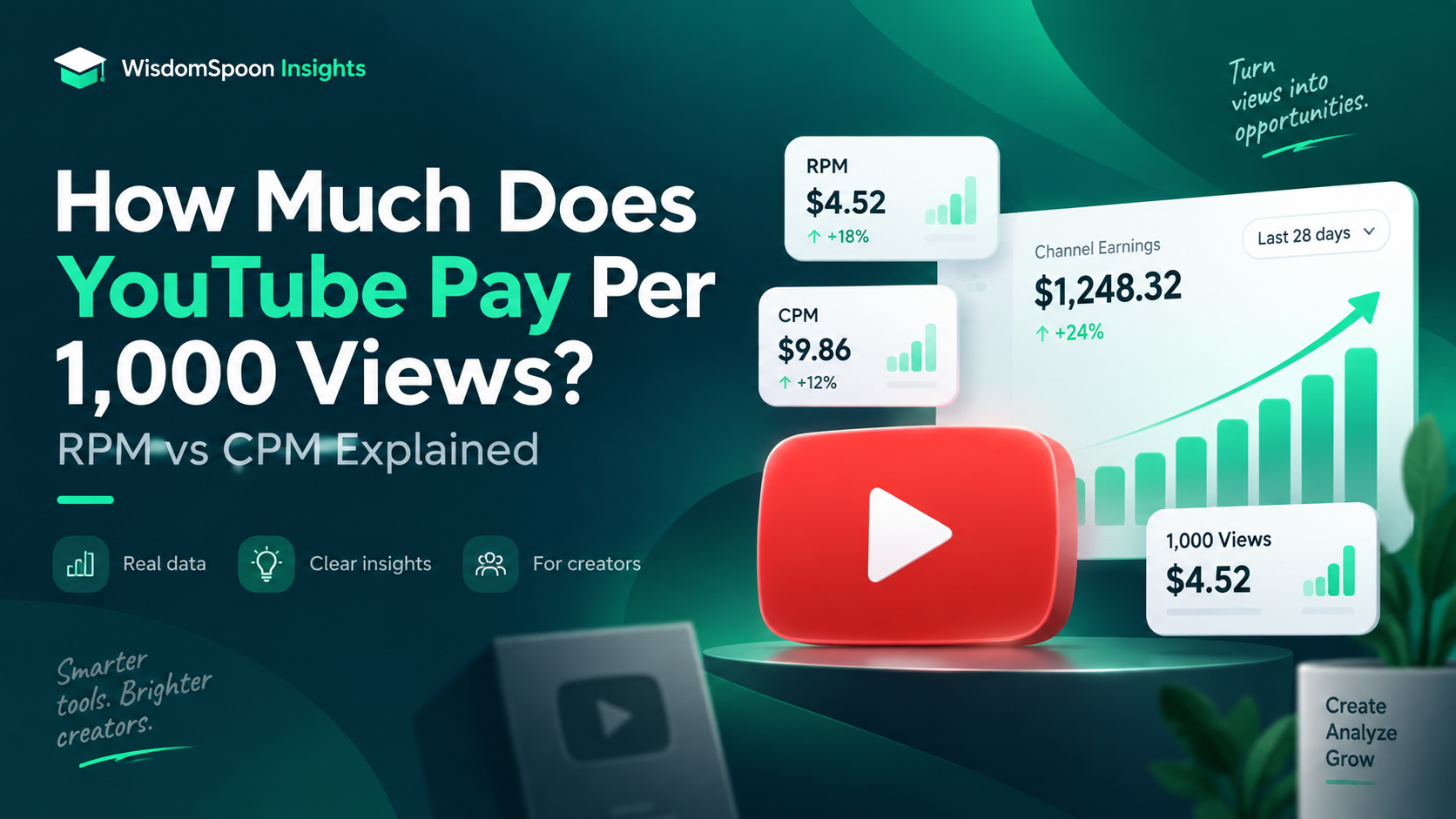
There is no fixed amount that YouTube pays for every 1,000 views.
One creator may earn only a few dollars from 1,000 views, while another may earn much more. Even two videos on the same channel can produce different earnings from the same number of views.
The reason is simple: YouTube revenue depends on more than views.
Audience location, advertiser demand, content type, seasonality, monetized playbacks, video length and other factors can all influence how much a channel earns.
For creators, the most useful number to understand is usually RPM — Revenue Per Mille, or revenue per 1,000 views.
YouTube defines RPM as a creator-focused metric that reflects revenue after YouTube’s revenue share and includes all video views, including views that were not monetized. RPM can also include revenue from sources such as ads, YouTube Premium, channel memberships, Super Chat and Super Stickers.
So instead of asking only:
“How much does YouTube pay for 1,000 views?”
a more useful question is:
“What is my RPM, and what is affecting it?”
The Basic YouTube Earnings Formula
A simple way to estimate revenue is:
Estimated Revenue = Views ÷ 1,000 × RPM
For example, if a channel has an RPM of $4:
- 1,000 views = about $4
- 10,000 views = about $40
- 100,000 views = about $400
- 1 million views = about $4,000
But the important point is that $4 is only an example RPM.
It is not a universal YouTube payment rate.
Here is how the same number of views could produce very different results:
| Views | $1 RPM | $3 RPM | $5 RPM | $8 RPM |
|---|---|---|---|---|
| 1,000 | $1 | $3 | $5 | $8 |
| 10,000 | $10 | $30 | $50 | $80 |
| 100,000 | $100 | $300 | $500 | $800 |
| 1,000,000 | $1,000 | $3,000 | $5,000 | $8,000 |
These are illustrative scenarios, not guaranteed earnings.
This is why a calculator is most useful when it lets you test different RPM assumptions instead of presenting one “average” as if it applies to everyone.
Try it: Use the WisdomSpoon YouTube Money Calculator to model different view and RPM scenarios.
RPM vs. CPM: What Is the Difference?
RPM and CPM are often confused, but they measure different things.
CPM
CPM stands for Cost Per Mille.
It represents what advertisers pay for 1,000 ad impressions before YouTube’s revenue share.
CPM is therefore mainly an advertiser-side metric.
RPM
RPM shows what the creator earns per 1,000 views after YouTube’s revenue share.
YouTube also includes all views in the RPM calculation, including views where no ad was shown. That is one reason RPM is usually lower than CPM.
So if your CPM is $12, that does not mean YouTube is paying you $12 for every 1,000 views.
That is one of the most common misunderstandings in YouTube revenue discussions.
For watch-page advertising, YouTube currently pays eligible partners 55% of net advertising revenue. Shorts use a separate revenue-sharing system, where creators receive 45% of the revenue allocated to them from the Shorts Creator Pool.
Why Two Channels With the Same Views Can Earn Very Different Amounts
Imagine two channels each receive 250,000 views in one month.
Channel A earns about $375.
Channel B earns about $1,500.
Both figures are possible.
Channel A would have an effective RPM of about $1.50.
Channel B would have an effective RPM of about $6.
The real question is not whether the numbers are possible.
The useful question is:
Why is one channel monetizing its views more efficiently than the other?
Several factors can explain the difference.
1. Audience Location
Advertisers do not value every market equally.
Advertising competition, purchasing power and marketing budgets differ between countries and regions.
YouTube itself notes that CPM can change when the geographic mix of a channel’s audience changes.
For example, a channel receiving more viewers from markets with higher advertiser demand may see stronger CPM and RPM than a channel receiving the same number of views from markets with lower advertiser competition.
This is why total views alone are not enough.
You also need to understand where those views are coming from.
2. Topic and Advertiser Demand
Some audiences are commercially more valuable to advertisers than others.
A viewer researching business software, financial products or professional services may attract a different level of advertiser competition than someone watching a broad entertainment clip.
That does not mean creators should abandon a subject they enjoy and chase the “highest-paying niche.”
It simply means that 100,000 views are not economically identical across every topic.
View count measures attention.
RPM helps measure how effectively that attention is being monetized.
3. Not Every View Shows an Ad
One of the biggest mistakes creators make is assuming:
1 view = 1 ad impression.
It does not.
YouTube distinguishes between:
- views,
- monetized playbacks,
- and ad impressions.
Some views may contain no ads at all. Others may contain more than one ad impression.
A viewer may not receive an ad because:
- no suitable ad is available,
- the viewer does not match advertiser targeting,
- the content has limited ad eligibility,
- the viewer uses YouTube Premium,
- or other factors affect ad delivery.
That is why multiplying total views by CPM is not a reliable way to calculate creator income.
4. Video Length Can Affect Monetization Opportunities
Longer videos can provide additional advertising opportunities.
YouTube currently allows mid-roll ads on monetized videos that are 8 minutes or longer.
However, simply making every video longer is not a good strategy.
If a topic can be explained well in five minutes, stretching it to ten minutes may reduce viewer satisfaction.
A better approach is:
Create the length the topic genuinely deserves.
When a useful video naturally runs longer than eight minutes, mid-roll opportunities may become an additional monetization advantage.
YouTube also notes that a mid-roll slot does not guarantee that an ad will actually be served.
5. Advertiser-Friendly Content Matters
A video can perform well with viewers but still have limited advertising opportunities.
YouTube applies advertiser-friendly content guidelines, and videos that do not meet those standards may receive limited or no advertising.
So if one video has strong views but unusually weak revenue, creators should check whether:
- the video received limited ads,
- the topic is sensitive,
- the title or thumbnail affects advertiser suitability,
- or monetization settings changed.
Do not automatically assume that YouTube simply “reduced the rate.”
There may be a specific reason.
6. Seasonality Can Change CPM and RPM
Advertiser demand changes throughout the year.
Some companies spend more heavily before major shopping periods or holidays, while other periods may have weaker advertising competition.
YouTube confirms that CPM can fluctuate due to time of year, audience geography and changes in available ad formats.
This means your RPM may move even if your content strategy has not changed.
That is why comparing one week with another can be misleading.
Longer-term patterns are much more useful.
Stop Chasing a Universal “Average RPM”
Creators often search for:
“What is a good YouTube RPM?”
or:
“What is the average YouTube RPM?”
Those numbers can be interesting, but they are often much less useful than your own data.
Suppose someone tells you that $4 is a “normal” RPM.
Your channel might operate at $1.50.
Another channel might operate at $8.
The average does not explain either business.
A better metric is:
Your RPM today compared with your own RPM last month, last quarter and across different types of content.
That gives you something actionable.
Use RPM as a Diagnostic Tool
Consider this example:
Month 1
200,000 views
$2.50 RPM
Estimated revenue: $500
Month 2
250,000 views
$2.00 RPM
Estimated revenue: $500
Views increased by 25%, but revenue stayed roughly the same.
That tells you something important:
The channel attracted more traffic, but each 1,000 views generated less revenue.
Now look at another example.
Month 1
200,000 views
$2.50 RPM
Estimated revenue: $500
Month 2
200,000 views
$3.50 RPM
Estimated revenue: $700
Views stayed flat, but revenue increased significantly.
That means the channel monetized the same amount of traffic more efficiently.
This is why RPM is not just an earnings number.
It can help you diagnose what is changing inside your channel.
How to Use WisdomSpoon’s YouTube Tools Together
The real value comes from using several metrics together instead of looking at one calculator in isolation.
Step 1: Check your real RPM
If your channel is monetized, start with actual data from YouTube Analytics.
Do not begin with an internet-wide average.
Step 2: Calculate and compare RPM
Use the WisdomSpoon YouTube RPM Calculator to understand how revenue and views translate into RPM.
Compare different months or different videos.
Step 3: Model future revenue
Use the YouTube Money Calculator to test scenarios.
For example:
- What if monthly views reach 100,000?
- What if RPM rises from $2.50 to $3.50?
- What if traffic doubles but RPM falls?
Scenario planning is more useful than believing one earnings estimate.
Step 4: Analyze channel momentum
Use the WisdomSpoon YouTube Channel Analyzer to examine recent channel performance.
Lifetime subscriber count can be impressive, but recent performance tells you much more about what is happening now.
Step 5: Look for the reason behind the number
If RPM changes significantly, investigate:
- audience geography,
- content topics,
- video format,
- advertiser suitability,
- traffic sources,
- seasonality,
- and changes in monetization.
The goal is not simply to collect metrics.
The goal is to understand why they moved.
Can You Increase Your YouTube RPM?
You cannot directly control what advertisers bid.
But you can improve the conditions around monetization.
Start by comparing your stronger and weaker RPM videos.
Look for patterns.
Ask:
- Do some topics consistently monetize better?
- Do certain countries generate stronger revenue?
- Are longer videos performing differently?
- Are some videos receiving limited ads?
- Has the channel attracted a different type of audience?
YouTube itself recommends looking at monetization settings, mid-roll opportunities and additional revenue features when trying to improve overall RPM.
But monetization should never come at the cost of viewer satisfaction.
A high-RPM video that nobody wants to watch is not a strong business strategy.
YouTube Income Is Bigger Than Ad Revenue
Advertising is only one part of the creator economy.
Depending on eligibility, creators may also earn through:
- YouTube Premium,
- channel memberships,
- Super Chat,
- Super Stickers,
- Super Thanks,
- sponsorships,
- affiliate marketing,
- products,
- services,
- and other business opportunities.
RPM itself can include several YouTube-based revenue sources, but it does not capture every way a creator may make money from an audience.
That is an important distinction.
A channel with modest advertising income can still become a valuable business if it creates strong commercial opportunities outside ad revenue.
So, How Much Does YouTube Pay Per 1,000 Views?
There is no universal answer.
If your RPM is $1, then 1,000 views represent roughly $1 of revenue.
If your RPM is $5, those same 1,000 views represent roughly $5.
If your RPM is $8, they represent roughly $8.
But those are mathematical examples, not fixed YouTube rates.
The more useful approach is to:
- know your own RPM;
- track how it changes;
- understand what is influencing it;
- compare revenue with view growth;
- use realistic scenarios to plan future earnings.
That gives you far more useful information than asking what YouTube “normally pays.”
Want to test your own numbers? Use the WisdomSpoon YouTube RPM Calculator and YouTube Money Calculator to model different revenue scenarios for your channel.
Frequently Asked Questions
Does YouTube pay the same amount for every 1,000 views?
No. YouTube does not use one fixed payment rate for every 1,000 views. Earnings depend on monetization, advertiser demand, audience characteristics and other factors.
Is CPM what a creator earns?
No.
CPM represents advertiser spending per 1,000 ad impressions before YouTube’s revenue share.
RPM represents creator revenue per 1,000 views after YouTube’s share.
Why is RPM lower than CPM?
YouTube explains that RPM is calculated after its revenue share and includes all views, including views that were not monetized.
Can a video with fewer views earn more money?
Yes.
A video with fewer views but a higher RPM can earn more than a video with more views but weaker monetization.
Are YouTube Shorts paid the same way as long-form videos?
No.
Shorts use a separate revenue-sharing model based on the Shorts Creator Pool, while long-form watch-page advertising uses a different revenue model.